_edited.jpg)





ENTER THE STORY
In a future where humanity is extinct and vampires rule Mars, Lexi – a troubled five-hundred-year-old immortal – is ordered to father a child with a mysterious clone named Primeva, whose very existence defies the laws of God and science. Before her fragile body fails, they must return to the ruins of Earth, where Lexi can reclaim his lost soul – for only as a mortal man can he unite with Primeva to restore humankind.
Vampire Daddy is partly inspired by C. S. Lewis's Space Trilogy, especially Perelandra – also, George MacDonald's Lilith. However, this novel depicts a world that Lewis and MacDonald did not dare to imagine, a world in which technocracy triumphed to the point of humanity's obliteration – and yet – civilization carried on, built by people who had willingly relinquished their souls. The novel asks: how do we find conscience and morality in the future if we follow hypertechnology past its endgame?

NEW TO VAMPIRE DADDY?
START HERE.
ENHANCEMENT. EXTINCTION. SUPREMACY.
When a modified vampiric viral medical treatment promises to end human suffering, 1 billion people sign up in the late 2020s.
Fast forward 550 years, and humans are extinct, although civilization continues. A new class of vampiric immortals views themselves as the next stage in human evolution. Since Earth is haunted by the ghosts of 9 billion people, the vampires, who can withstand the physical challenges of space exploration, build an empire on Mars.
Little do they realize that their story is one chapter in the long saga of the solar system. Mars is about to wake up – and give them a terrifying history lesson.
Their only hope is to reverse the process and recover their souls, though a love that revives the memory of everything in the ruined human condition.
THAT LOVE SETS THE STAGE FOR THE STORY OF
LEXI & PRIMEVA.

READ FOR FREE
The first four installments are free, as is the opening of every chapter. Also free to read is Chapter 22 (You Could Be A Villain). More free material is in the World-Building section, below.

EXPLORE THE ARCHIVE
Visit the Vampire Daddy Table of Contents on this website for a complete list of chapters with direct links to read on Patreon and Substack.

THEN GO FURTHER
If you enjoy the story, subscribe on Substack or Patreon for full chapters, behind-the-scenes material, character files and exclusive extras.

WORLD-BUILDING

THE MARTIAN GOTHIC


Vampire Daddy is a Gothic romantic space epic that blends science fiction, horror, theophany, alternative history and the fantastic.
Although it uses the machinery of genre fiction, its concerns are literary: love and loss; the nature of the self and the soul; time and technological transformation.
The style of the novel combines mystical realism with sacramental realism to speculate on the human experience in ways that realism cannot.
NEWS
 FIRST 100 SUBS20 July 2026: 'Vampire Daddy' Substack hit 100 subs! |  Substack Write Club5 August 2026: VAMPIRE DADDY featured on WRITE CLUB |  Cocktails Anyone?Thanks to David Etheredge for the 'Vampire Daddy' Cocktail recipe! |  200 SUBS19 August 2026: 'Vampire Daddy' Substack hit 200 subs! |
|---|---|---|---|
 300 subs15 Sept. 2026: 'Vampire Daddy' Substack hit 300 subs! | 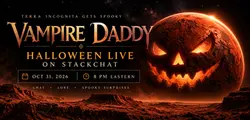 HALLOWEEN!LC will be live on STACKCHAT! |


